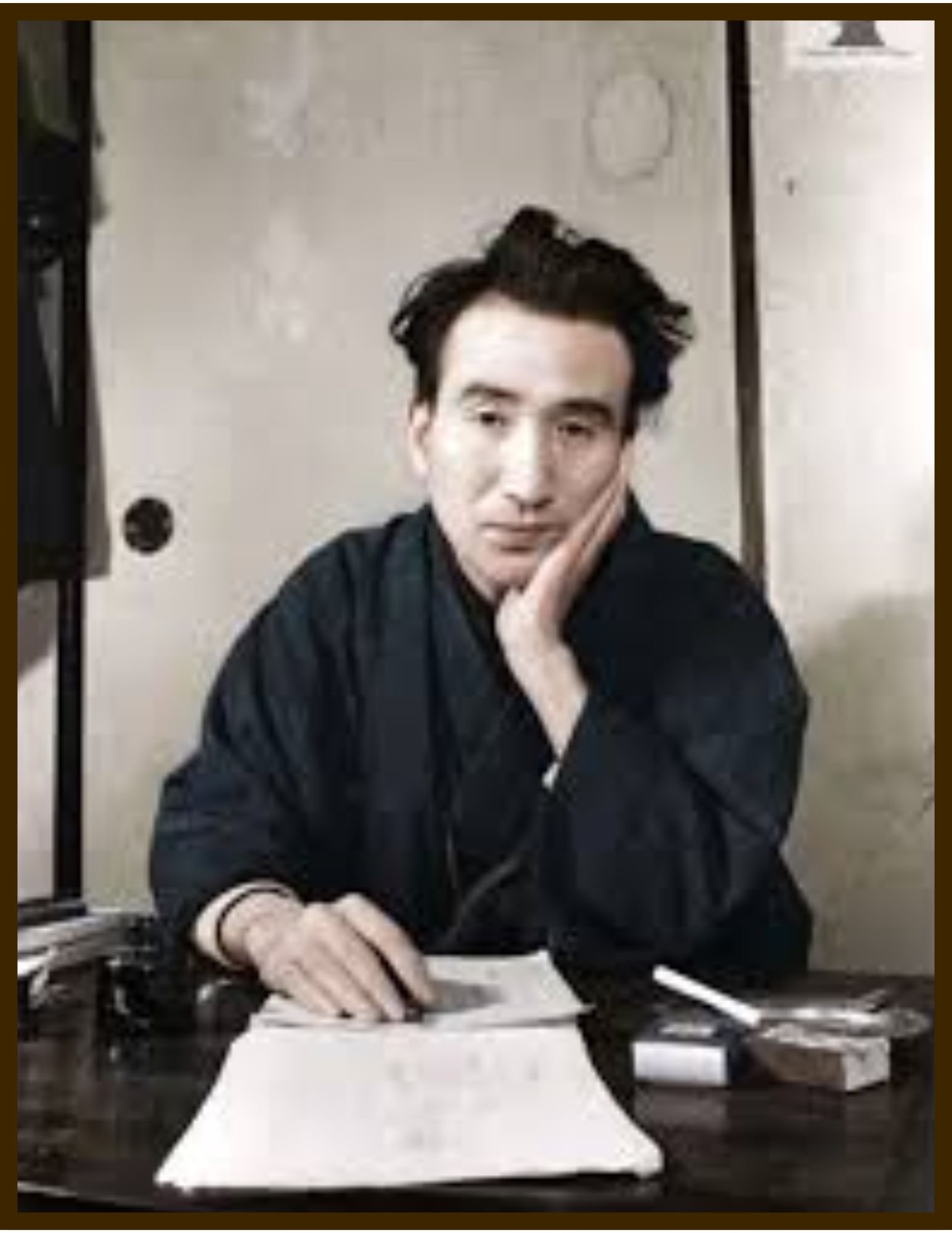
Who was Osamu Dazai?
Osamu Dazai (1909–1948) was an essential voice of postwar Japanese literature, articulating the despair, alienation, and moral exhaustion of a nation in transition. Born Shūji Tsushima to a wealthy, politically influential landowning family in the northern prefecture of Aomori, he abandoned his aristocratic roots and formal education to pursue a literary career defined by intense autobiographical scrutiny. His writing consistently examined the beauty of human weakness and the heavy cost of social conformity.
Dazai’s life was marked by profound instability and self-destruction. Raised largely by a wet nurse and an aunt due to his mother’s ill health and his father’s political absences, he felt a deep, enduring detachment from his family. In 1930, he enrolled in the French literature department at Tokyo University but rarely attended lectures, ultimately leaving without a degree. That same year, he survived the first of several suicide attempts, a double suicide with a bar hostess in which only the woman died. The subsequent decade brought further chaos, including involvement in illegal leftist political activities, confinement in a mental institution, and severe narcotic addiction.
Despite his erratic personal life, Dazai possessed a formidable, disciplined literary talent. During the militaristic conformity of World War II, he was one of the few Japanese writers to maintain his artistic integrity. According to scholars, Dazai managed to sustain his literary output and publish novels without compromising his vision or producing state propaganda, a period during which many of his peers either fell silent or capitulated to nationalist demands.
He achieved his greatest prominence in the immediate postwar period, capturing the specific psychology of a defeated, rapidly changing society. His 1947 novel The Setting Sun documented the decline of the Japanese aristocracy so precisely that its title became a permanent phrase in the national vocabulary. The term "people of the setting sun" entered common usage to describe those impoverished and dislocated by the war's aftermath, inflation, and land reforms.
The following year, Dazai completed his defining work, No Longer Human (1948). The novel offers a stark, unsentimental examination of an individual fundamentally incapable of understanding or connecting with human society. The protagonist adopts the mask of a clown to survive the casual cruelties and rigid expectations of the world around him. Shortly after submitting the manuscript, Dazai drowned himself in Tokyo's Tamagawa Reservoir alongside his mistress, Tomie Yamazaki. Their bodies were discovered on June 19, 1948, which would have been his thirty-ninth birthday.
Dazai's enduring appeal is due to his unsparing honesty and his refusal to romanticize suffering. He stripped away the polite fictions of Japanese society to examine shame, hypocrisy, and the quiet nobility of those broken by the world. By blurring the line between fiction and reality, he created a profound intimacy with his audience. His work remains widely read today, particularly among readers who recognize in his prose the universal struggle to exist within normalizing systems. As Dazai himself observed regarding the necessary subversion of literature, "Art dies the moment it acquires authority."
Stay updated on our latest releases
Time Warp Editions publishes classic, often forgotten or overlooked, works of literature from around the world, tailored to the modern reader.